⚡ Auto Brief: This content is part of our real-time syndication stream.
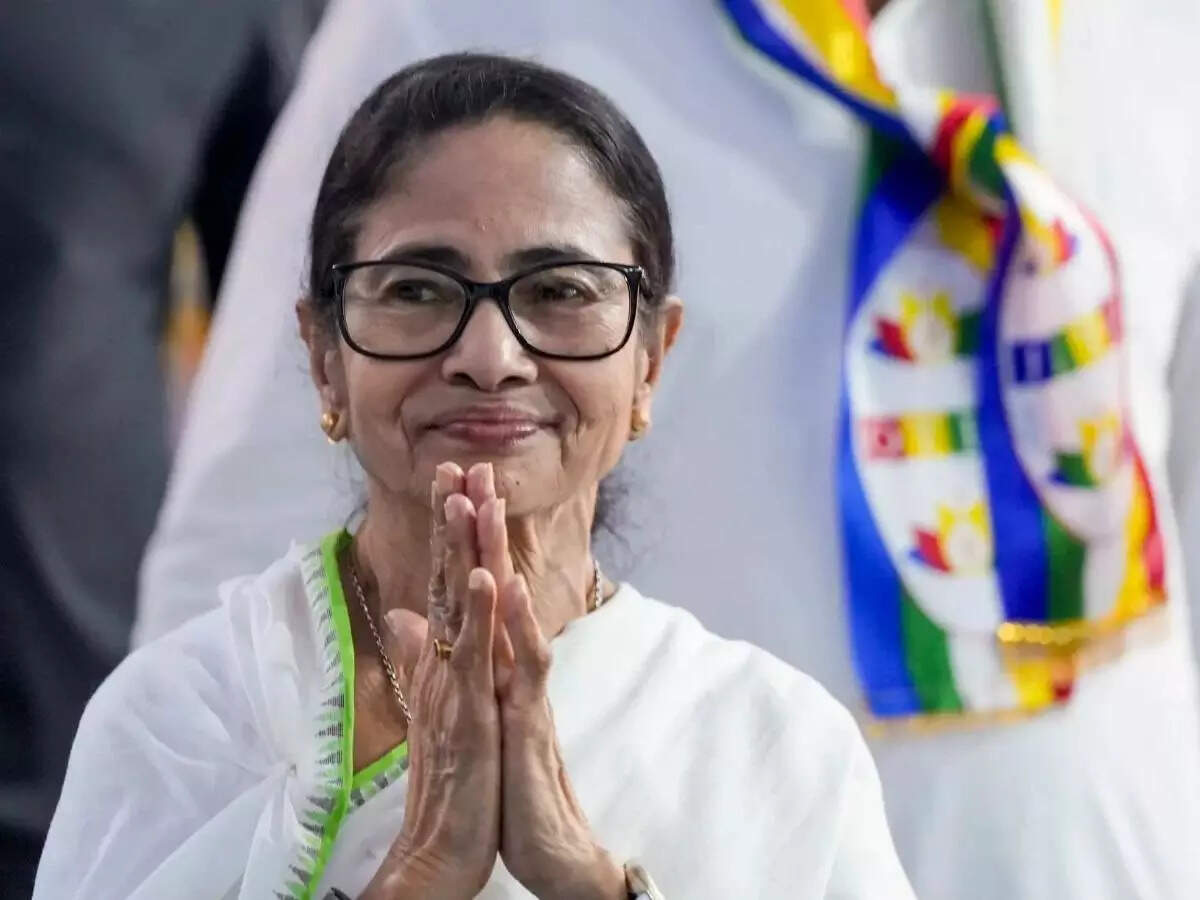
On 20 May 2011, it was a humid summer afternoon in Kolkata. Crowds gathered outside Raj Bhavan as Mamata Banerjee took oath as the first woman chief minister of West Bengal. The moment marked the end of a 34-year Left Front rule and the beginning of a new political chapter.Having visited the Kalighat Kali Temple earlier that day, Mamata arrived at the Governor’s residence shortly before 1 pm. Dressed in her trademark white cotton sari with a blue border and a tricolour uttariya draped over her shoulders, she took the oath in the name of Ishwar in Bengali at exactly 1.01 pm, a time chosen as auspicious by her family priest.
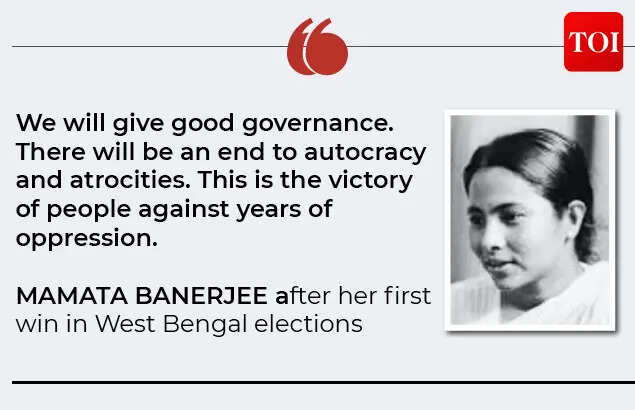
Accusing the communists of failing West Bengal’s 90 million people and contributing to economic decline, she declared, “We will give good governance. There will be an end to autocracy and atrocities. This is the victory of people against years of oppression.”
.
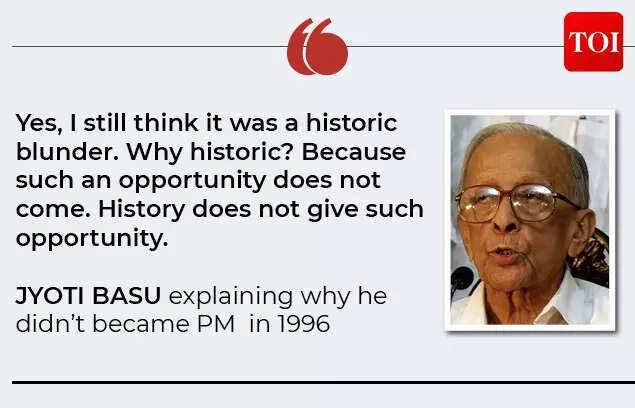
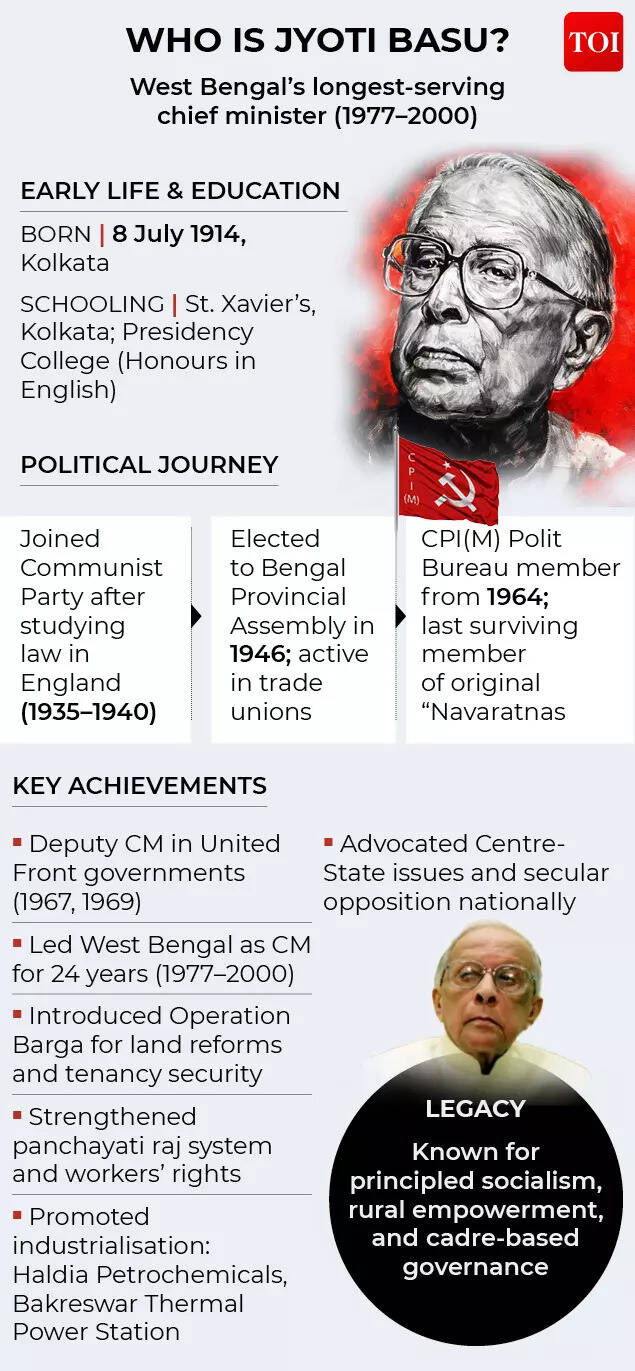
For over three decades, West Bengal had been governed by the Left Front, first under Jyoti Basu from 1977 to 2000 and then under Buddhadeb Bhattacharjee from 2000 to 2011. Bhattacharjee sought to industrialise the state and attract private investment, but the controversies over land acquisition in Singur and Nandigram weakened the Left’s rural base, paving the way for Mamata Banerjee’s decisive victory in 2011.It was, however, Basu who had built that formidable political edifice in the first place. Serving as chief minister for 23 consecutive years, Basu led the Left Front to repeated electoral victories, establishing one of the longest uninterrupted elected governments.His tenure was defined by sweeping land reforms such as Operation Barga, which strengthened tenancy rights and by the deepening of the three-tier panchayati raj system that decentralised power to rural bodies. In 1996, he was proposed as Prime Minister by the United Front alliance, but the CPI(M) declined to join the government, a decision Basu later described as a “historic blunder.”
.
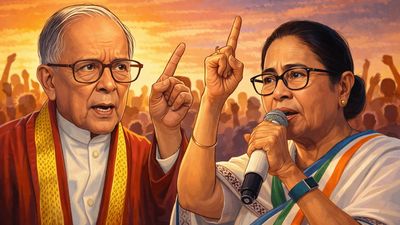
As West Bengal gears up for the 2026 Assembly elections, understanding the state’s political grammar requires revisiting the legacies of two of its longest-serving chief ministers, Jyoti Basu and Mamata Banerjee, whose contrasting models of governance have shaped the state’s political and economic trajectory.
Model I: Structural land reform and cadre consolidation under Jyoti Basu (1977–2000)
When Jyoti Basu assumed office in 1977, West Bengal was grappling with political instability, food shortages and industrial decline. Over the next 23 years, he built a governance framework anchored in structural agrarian reform and decentralised rural power.
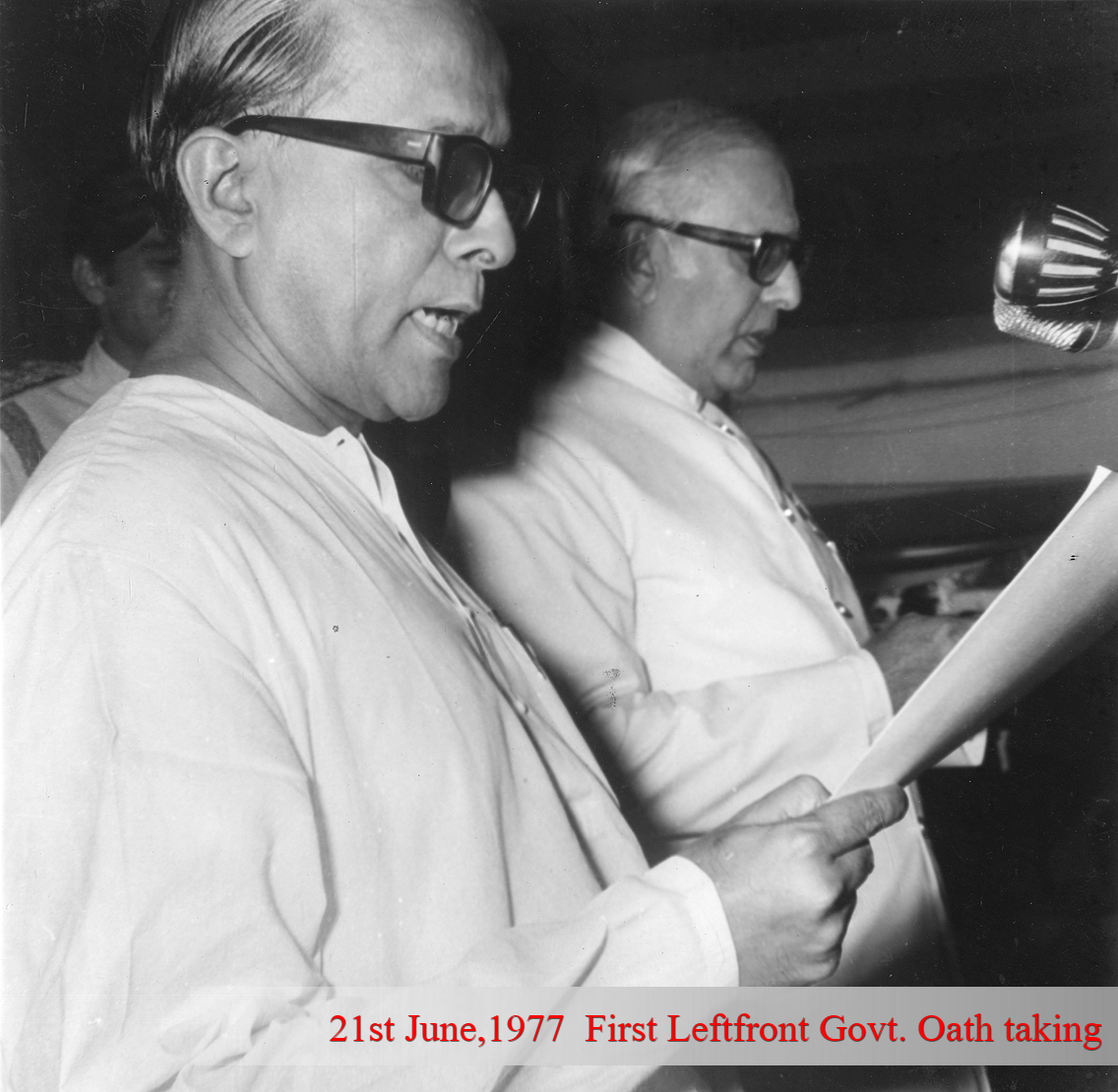
A defining pillar of his tenure was Operation Barga, a land reform programme that recorded and legally protected sharecroppers, significantly enhancing tenancy security. By the early 1990s, nearly 1.5 million bargadars (sharecroppers) had been registered and millions of acres of ceiling-surplus land were redistributed among the rural poor. Alongside land reforms, Basu strengthened the three-tier panchayati raj system, devolving administrative and financial powers to elected rural bodies. However, Basu’s tenure also faced persistent criticism over industrial stagnation during the 1980s and early 1990s. While land reforms improved rural equity, industrial growth lagged behind western and southern states. Frequent labour strikes and militant trade unionism during the 1980s contributed to the perception of Bengal as industry-unfriendly, leading to companies moving out of the state and slower private investment. By the late 1990s, questions about job creation, urban infrastructure and economic diversification were becoming more pronounced. By the time Basu stepped down in 2000, the Left’s political machinery remained formidable, but the economic anxieties were visible. His successor, Buddhadeb Bhattacharjee, attempted to correct this imbalance through rapid industrialisation, but failed to do so.
Model II: Income support and welfare-driven rural stabilisation under Mamata Banerjee (2011–Present)
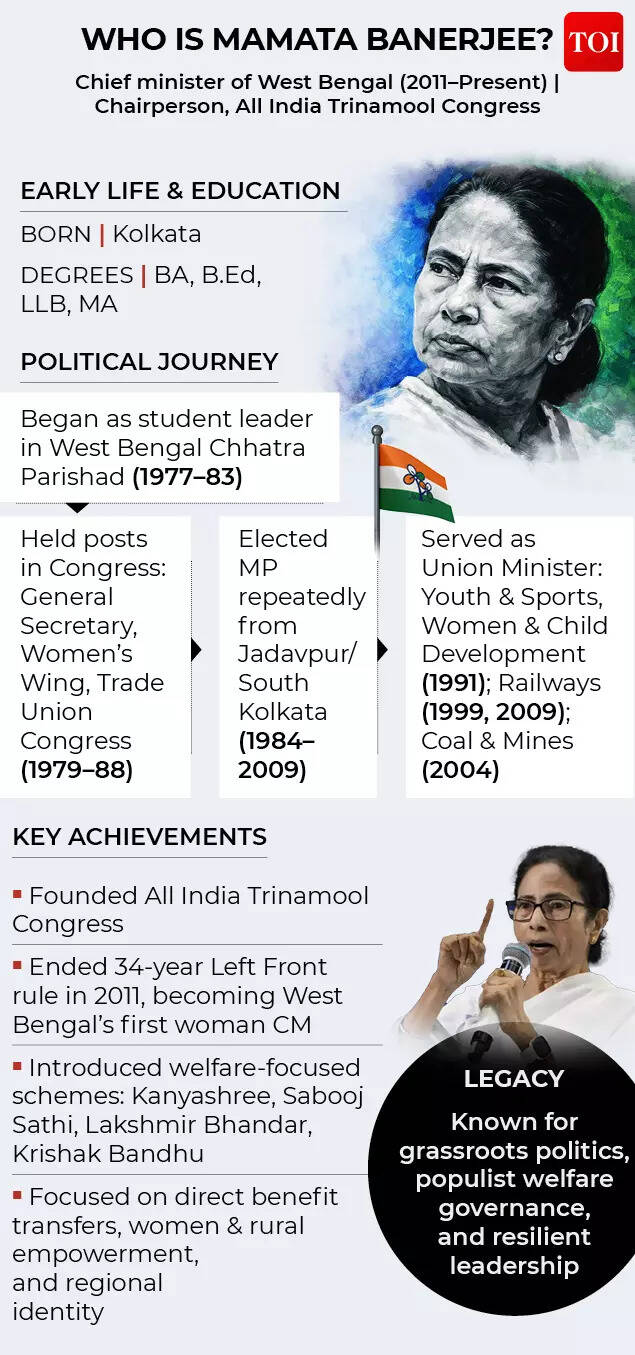
When Mamata Banerjee took office in 2011, she inherited a countryside once reshaped by redistribution but unsettled by industrial conflict. Unlike Basu’s structural reform approach, her governance strategy leaned heavily on targeted welfare schemes, direct benefit transfers and symbolic political messaging centred around “Maa, Mati, Manush.”

One of her first major decisions was the return of acquired farmland in Singur to unwilling farmers, a move that symbolically reversed the previous government’s industrial land acquisition policy. Over time, her administration shifted from structural land reform to direct financial assistance, most notably through schemes such as Krishak Bandhu. Under the programme, farmers and sharecroppers receive Rs 10,000 per acre annually in two instalments. The scheme now covers over 1.09 crore beneficiaries, with Rs 2,930 crore disbursed in the latest cycle directly into bank accounts. Since its launch in 2019, more than Rs 24,000 crore has been allocated under the scheme. It also provides Rs 2 lakh as social security assistance to families of deceased farmers, benefiting nearly 1.46 lakh households.Where Basu’s reforms focused on strengthening agrarian structures, Banerjee’s model prioritised in providing stability and income support.
Welfare architecture: Institutional reforms vs targeted cash transfers
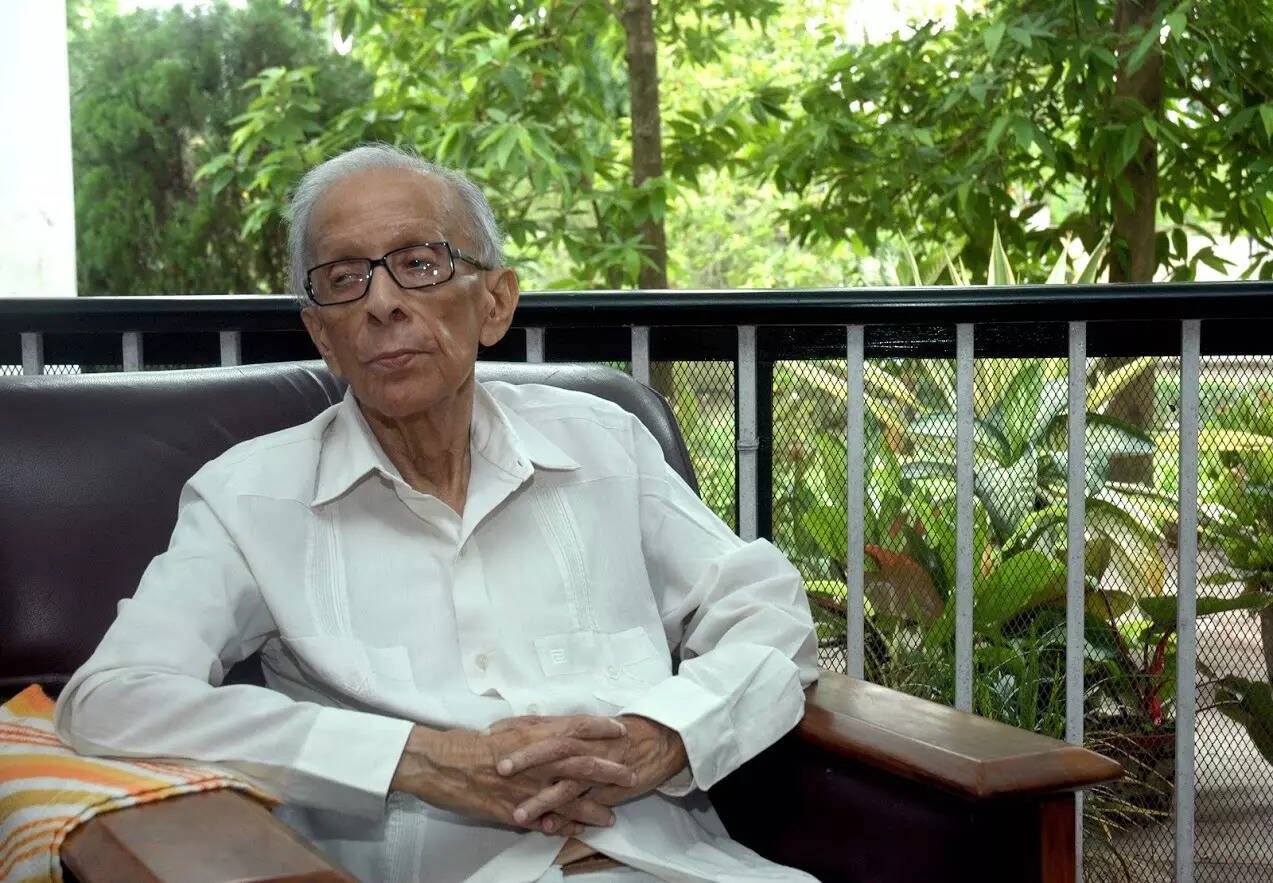
Under Jyoti Basu: Institutional and structural welfareUnder Jyoti Basu, welfare was embedded within structural reform rather than delivered through direct cash transfers. The emphasis was on land redistribution, tenancy security and decentralised governance through empowered panchayats. Rural employment, agricultural credit expansion and food distribution systems were strengthened through state-backed institutions rather than personalised beneficiary schemes.
Education and public health spending expanded gradually during the Left Front years, with a focus on government schools, primary healthcare centres and rural outreach. The model relied heavily on institutional delivery and cadre-driven implementation. Welfare, in this framework, was tied to class-based redistribution and long-term social restructuring rather than immediate financial assistance.Under Mamata Banerjee: Direct benefit transfers and beneficiary-centric governanceIn contrast, Mamata Banerjee built a welfare architecture centred on direct financial assistance and identifiable beneficiaries. Her administration rolled out a series of targeted schemes aimed at women, farmers, students and vulnerable households.
Programmes such as Kanyashree (financial support for girls’ education), Sabooj Sathi (bicycles for students), Lakshmir Bhandar (monthly cash support for women) and Krishak Bandhu (income support for farmers) reoriented the state’s welfare strategy toward predictable cash flows and household-level impact. Benefits were increasingly transferred directly into bank accounts, strengthening the government’s connection with individual beneficiaries.
Left front vs TMC: Education and health models
Jyoti Basu’s era: Expansion in education infrastructure and healthcare restructuringUnder successive Left Front governments led initially by Jyoti Basu, West Bengal saw significant expansion in education infrastructure. Literacy rates rose from 38% in 1977 to 68% in 2001 and further to 77% in 2011.
.
In healthcare, the Left initially attempted systemic restructuring. A rural three-tier health model was introduced, linking primary health centres to district hospitals and state-run medical colleges as referral institutions.Infrastructure expanded and budgets were allocated. Infant mortality declined at one of the fastest rates in the country during the latter years of the Left. The seventh Left Front government also launched health insurance schemes covering around 25 lakh workers in the unorganised sector.Mamata Banerjee’s era: Subsidy-driven access and household coverageUnder Mamata Banerjee, education and health policy shifted toward direct household-level support and universal coverage schemes. In education, programmes such as Sikshashree (textbook grants) and Sabooj Sathi (distribution of bicycles to students) aimed to reduce dropout rates and improve mobility for rural students, particularly girls. The emphasis moved from expanding institutions to improving access and retention through targeted benefits.In healthcare, the flagship Swasthya Sathi scheme provides cashless treatment coverage of up to Rs 5 lakh per family and reportedly covers over 2.5 crore households. The scheme positions the state as a primary guarantor of hospital expenses for lower-income families, supplementing national health programmes. Immunisation coverage and key health indicators have continued to improve, supported by both state initiatives and central schemes.
Industry, infrastructure and economy: Structural shifts across two eras
Left Front era: Industrial slowdown and late pragmatismUnder Jyoti Basu, the Left Front inherited an industrial base concentrated in Kolkata, Durgapur, Howrah, Hooghly and the mineral-rich western belt. However, its early industrial policy (1978) prioritised small-scale and cottage industries to generate employment and curb the dominance of large business houses and multinational corporations. New foreign investment was effectively discouraged.Labour militancy, frequent strikes and a perception of an adversarial business climate contributed to industries relocating to western and southern states. Private investment slowed, and Bengal’s share in national industrial output declined over time.A shift came in 1994 when the Left Front announced a liberalised industrial policy welcoming private and foreign investment. Priority sectors included petrochemicals, IT, steel, textiles and tourism. TMC era: Investment outreach, IT expansion and fiscal balancingWhen Mamata Banerjee assumed office in 2011, her government sought to reposition West Bengal as investment-friendly while distancing itself from the contentious land acquisition policies of the late Left period.
.
A major recent step was the introduction of the Revocation of West Bengal Incentive Schemes and Obligations like Grants and Incentives Bill, 2025, which scrapped the 2001-era incentive structure introduced under the Left.Her administration has aggressively promoted IT and services. Salt Lake Sector V, often dubbed Kolkata’s “Silicon Valley” hosts around 2,800 IT and ITeS firms, employing roughly 2 lakh professionals as of 2023. The state has also pushed mining projects in coal and shale gas, green technology initiatives, tourism expansion and infrastructure upgrades, including metro rail extensions and airport proposals.
Mamata Banerjee vs Jyoti Basu: Electoral report card
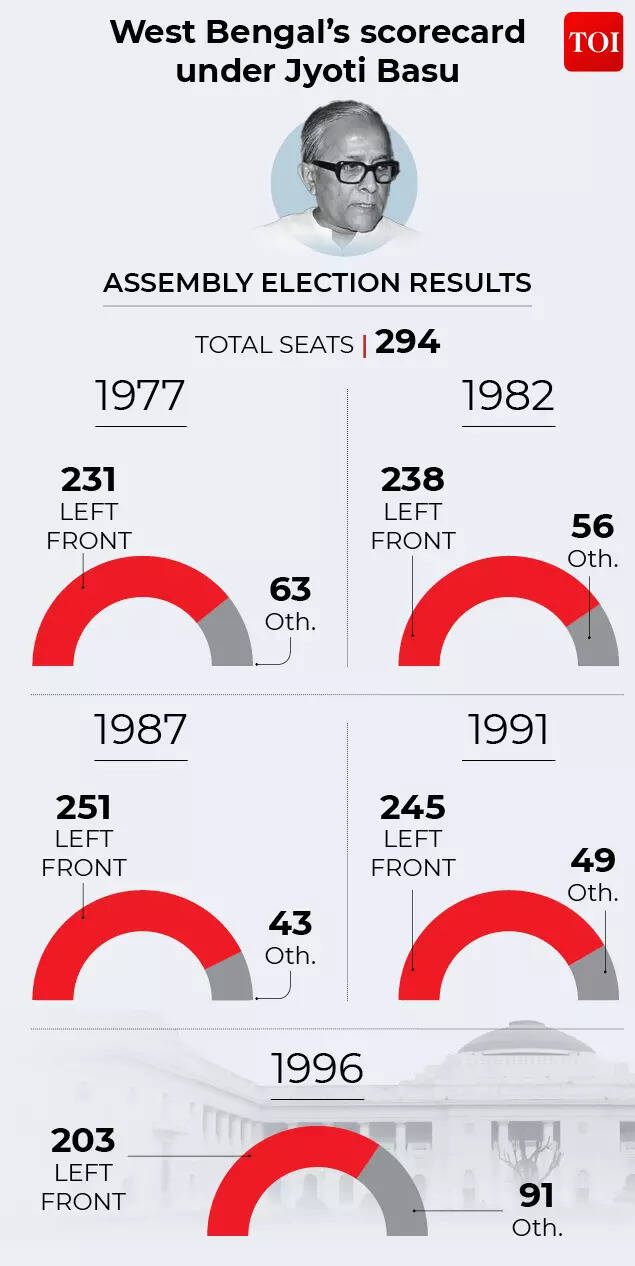
Under Jyoti Basu, the Left Front established one of the longest uninterrupted electoral reigns in Indian politics. Between 1977 and 2000, Basu led the coalition to five consecutive Assembly victories – 1977, 1982, 1987, 1991 and 1996. In each victory, his party had secured stable and often comfortable majorities.
.
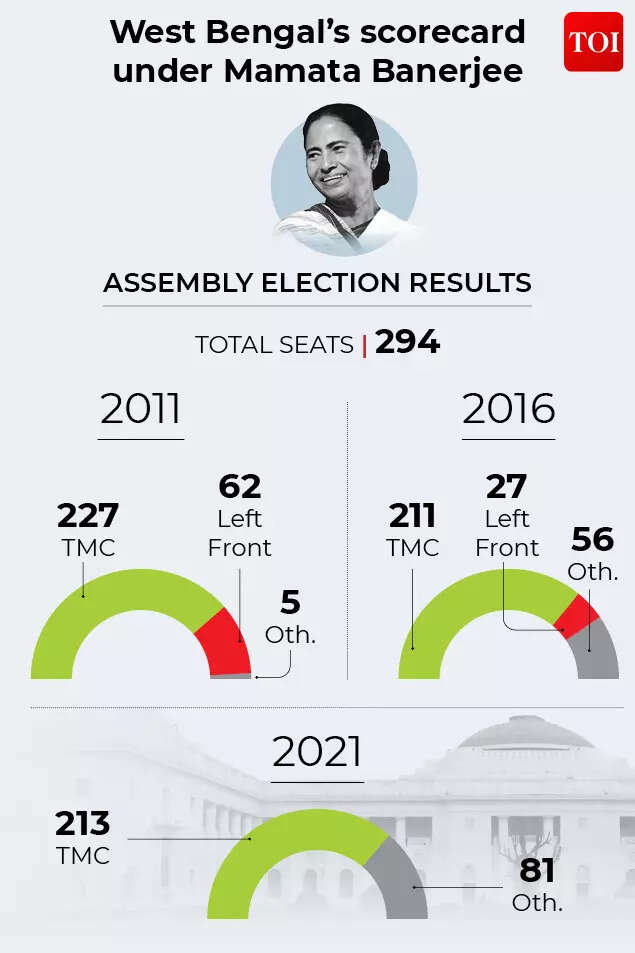
The strength of the Left during this period lay in its deeply embedded rural network, disciplined cadre structure and consolidation of peasant support through land reforms. By the time Basu stepped down in 2000 due to health reasons, the Left’s political machinery was so entrenched that it retained power between 2001 and 2011 under Buddhadeb Bhattacharjee.Basu’s electoral legacy was defined by ideological consistency and organisational discipline. However, by the late 2000s, fatigue within the ruling establishment and unrest over industrial land acquisition eroded the Left’s dominance, setting the stage for political transition.The turning point came in 2011 when Mamata Banerjee and her party, the All India Trinamool Congress, ended the Left Front’s 34-year rule. In that landmark election, the TMC won 184 of 294 seats on its own and, with allies, secured a decisive majority of around 227 seats. Banerjee became the first woman chief minister of West Bengal and the first non-Left leader since 1967.
.
Her dominance strengthened in 2016 with an even larger mandate, reinforcing the TMC’s position as the state’s principal political force. In 2021, despite an aggressive campaign by the Bharatiya Janata Party (BJP), Banerjee secured a third consecutive term with 213 seats, a result widely interpreted as a consolidation of her welfare-centric governance model and appeal to regional identity.Unlike the Left’s cadre-based ideological mobilisation, Mamata’s electoral strategy has relied heavily on direct welfare delivery, cash assistance schemes and targeted benefits to women, students and rural households.
Conclusion: Bengal’s next political test
As West Bengal approaches the 2026 Assembly elections, the contrast between these two models has never been sharper.Jyoti Basu institutionalised a cadre-driven, ideology-led governance structure rooted in land reform and class mobilisation. Mamata Banerjee, in contrast, has centralised political authority while expanding direct welfare delivery and targeted income support.The state’s political grammar has shifted: from structural redistribution to beneficiary-based governance and from party organisation to personalised leadership. The next big question is whether Bengal is ready to continue along the path it has chosen or whether 2026 will signal the beginning of another new political chapter?
Source: Times of India
📝 We use smart aggregation to bring you top news in real-time.