📰 Quick Update: This article is sourced from reliable publishers using automation.
US-Israel-Iran war impact: Indian equity benchmarks, Nifty50 and BSE Sensex, will see mounting pressure in the coming days if the Middle East crisis persists, feel analysts. Indian stocks, already under pressure, are expected to fall further behind global markets as rising tensions in the Middle East drive crude prices higher, weighing heavily on oil-importing economies, experts have said.India’s equity market, valued at around $5 trillion, has trailed most major global peers since late 2024 due to slower profit growth and limited participation in artificial intelligence-linked stocks. The sharp rise in oil prices, the country’s largest import, has stalled an early rebound in equities that followed India’s trade agreement with the United States. Analysts warn that higher energy costs could stoke inflation and put pressure on economic growth and the rupee.
Indian stocks to bleed more?
According to Goldman Sachs, Indian companies could be among the hardest hit in Asia by the conflict involving Iran. A Bloomberg report quoting Goldman Sachs said that a 20% increase in Brent crude prices would reduce regional earnings by about 2%. Societe Generale also sees scope for India’s relative underperformance to intensify because of its heavy dependence on imported fuel, while Natixis has described Indian assets as the most vulnerable on this front.
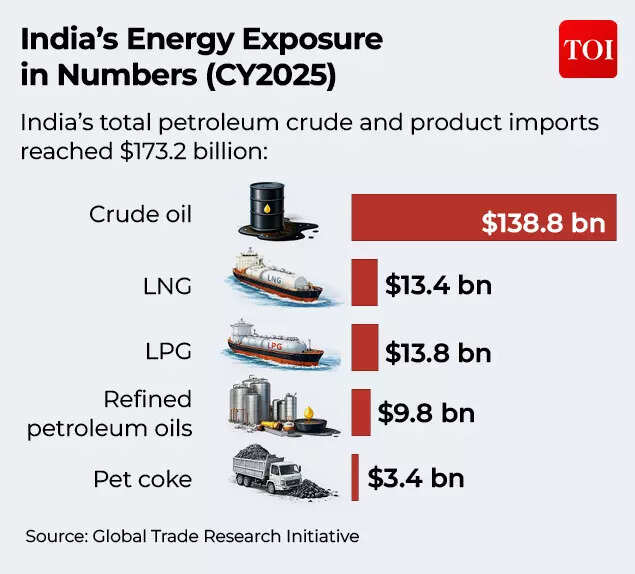
“With tensions in the Middle East showing little sign of cooling, supply-side risks remain elevated, allowing oil prices to push higher in the near term,” said Dilin Wu, a research strategist at Pepperstone Group. “India’s strong dependence on imported crude, much of it sourced from the Gulf, leaves its markets exposed. If oil prices stay elevated for longer, the import bill could expand, the current account and currency could come under strain, and equities may face added pressure,” Wu was quoted as saying by Bloomberg.Past trends suggest that such weakness could persist in the near term. During the early phase of the Russia-Ukraine conflict, the Nifty declined by roughly 10% in the first half of 2022, Citigroup analysts led by Samiran Chakraborty noted in a report. “A 10% rise in oil prices leads to 30 basis points of upside pressure on inflation and 15 basis points downside on growth,” they said.However, not all market participants share a cautious outlook. BNP Paribas believes Indian equities could outperform in the months ahead, arguing that the balance of risk and reward appears tilted in favour of gains.Even so, a growing number of investors are positioning away from Indian stocks. SocGen has advised taking long positions in Asia excluding Japan while shorting Indian equities. Meanwhile, Sanford C. Bernstein cautioned that a prolonged conflict involving Iran could continue to weigh on the benchmark.A sustained escalation “could push the Nifty below 24,500,” Bernstein analysts led by Venugopal Garre wrote in a note. “In particular, we see higher risk for energy, travel and trade-linked names, and construction companies with meaningful Middle East and North Africa exposure.”(Disclaimer: Recommendations and views on the stock market, other asset classes or personal finance management tips given by experts are their own. These opinions do not represent the views of The Times of India)
Source: Times of India
📝 We use smart aggregation to bring you top news in real-time.