📢 Headline Alert: Stay informed with curated news directly from top media sources.
[ad_1]
Chandra Grahan, or a total lunar eclipse, will happen on March 3, 2026. This is a rare astronomical event that will happen at the same time as the Hindu holiday Holi, which is full of color. People in India and all over the world are excited about it.
What will happen on the third of March?
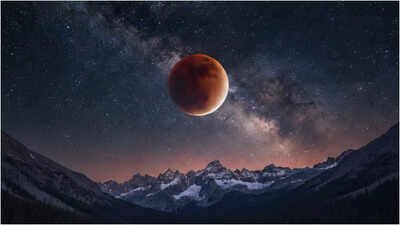
The Earth will be between the Sun and the Moon on Tuesday, March 3, 2026, and the Moon will be in the Earth’s shadow. When the full Moon moves into the Earth’s deep shadow, or umbra, this alignment causes a total lunar eclipse. The Moon looks red a lot of the time because sunlight bends through Earth’s atmosphere. That’s why it’s called the ‘Blood Moon.’
Astronomical data show that this is the first lunar eclipse of the year 2026. It is one of many eclipses that can be seen in the Americas, Australia, the Asia-Pacific region, and the Indian subcontinent.Indian Standard Time (IST) is the time in India.
- On March 3, the eclipse will start in the afternoon and end in the early evening. It will last for a few hours.
- The eclipse will start around 3:20 PM IST.
- Between 6:33 and 6:40 PM IST will be the best time to see the eclipse.
- The eclipse will end at 6:47 PM IST.
On the other hand, the Moon rises later in the evening in India. The only part of the eclipse that you will be able to see is the last part, which will happen around moonrise. This will happen in cities like Delhi, Mumbai, Bengaluru, and Chennai between 6:20 and 6:30 PM IST.People in northeastern states like Assam, Arunachal Pradesh, Meghalaya, and Bengal will be able to see the eclipse better because the Moon rises earlier there.
What people in India will be able to see
When the totality phase ends and the Moon looks very red, most people in India will only be able to see parts of the eclipse. This happens because the Moon will start to rise while the eclipse is still going on.For example, people in Chennai might be able to see the last part of the total lunar eclipse for about 31 minutes after the sun goes down. People in Cuttack, on the other hand, might be able to see it for a longer time.In Kolkata and some parts of eastern India, you might be able to see as much as 90% of it. But in big cities in the middle and western parts of the country, you might only be able to see a small part of it when the moon rises.
What does the word ‘Blood Moon’ mean?
The Earth casts a shadow on the full Moon, and the only light that gets to it comes from the Earth’s atmosphere. This light spreads out shorter blue wavelengths and lets longer red wavelengths shine on the surface of the moon. This is why the moon is a striking reddish or coppery color, which is why people call it the “Blood Moon.”Astronomers have looked into this color change. It’s not dangerous for anyone who sees it; it’s just a change in how things look and feel. Unlike a solar eclipse, you don’t need special eye protection to see a lunar eclipse.
Important for Science and Astronomy
From a scientific point of view, lunar eclipses are great times to learn about how the Moon and Earth affect each other and how the atmosphere affects them. Scientists can use them to learn how the atmosphere changes sunlight and even make educated guesses about what the atmosphere is made of.This full Moon eclipse is also a chance for both amateur and professional astronomers to hold events where people can look at the sky, take pictures of the stars, and do social science outreach. Astrologers and other important cultural groups often talk about how the Purva Phalguni Nakshatra is where the eclipse happens in the Leo zodiac sign.
Crossing with Holi and other cultural traditions
This event in the sky is very important in India because it happens on Holi, a holiday that celebrates colors and joy. The lunar calendar and Phalguna Purnima, which is the full moon, usually tell us when Holi is. This year, it falls on the same night as the lunar eclipse.Astrologers, cultural critics, and Hindu scholars have been talking about when to celebrate, do rituals, and Sutak Kaal, which is a time when people usually don’t do good things before eclipses.Many customs say that you should plan certain good deeds or religious activities around the eclipse to stay pure. Different groups, families, and places have very different ways of doing things. Because the eclipse happens on a big holiday, people are more interested in it and look at religious calendars more often.
Safety tips and how to watch
- You can see a lunar eclipse without any special filters, but you need them to see a solar eclipse. But to make things better:
- The best time is when the sky is clear and you can see the horizon to the east.
- Binoculars or small telescopes will help you see the Moon’s changing colors and phases more clearly.
- To get the best view, go somewhere that is open and far away from city lights.
- For people who can’t be there in person, many scientific groups and space services are expected to stream the event live around the world.
What comes next on the calendar for the eclipse?
After the lunar eclipse on March 3, the next big eclipses in India are:
- On February 20, 2027, there will be a penumbral lunar eclipse.
- A solar eclipse that only covers part of the sun will happen on August 2, 2027.
- There will be more solar and lunar eclipses in 2028 and 2029.
Still, the 2026 eclipse is the easiest and most culturally important one for people in India to see this year.
[ad_2]
Source link
Source: Times of India
📝 All news content is syndicated with source attribution for transparency.