📰 Quick Update: This article is sourced from reliable publishers using automation.
[ad_1]
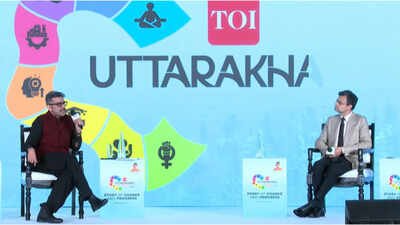
NEW DELHI: The Times of India’s flagship Uttarakhand Transformation Dialogues 2026 brought together policymakers, academics and industry leaders in Dehradun on Friday, with a sharp focus on the state’s next phase of growth.Among the key sessions was a fireside chat featuring scientist and author Anand Ranganathan, who spoke on the theme “Digital Education, Governance & Public Reason”. The session explored how digital platforms, education and governance shape public discourse and policy outcomes.The larger event, organised by The Times of India, aims to create collaboration between government, industry and civil society.
Public reasoning has increased in the digital era
Opening the discussion, the moderator asked whether the scope of public reasoning in society has grown or shrunk in the digital age.Ranganathan was clear in his response.“It has certainly increased. There is no two ways about it,” he said.Recalling the 1970s and 1980s, he noted that earlier generations had very limited avenues to respond to opinions published in newspapers or aired on radio and television.“If we didn’t like it, the only option was to roll up the newspaper and fling it against the wall. On rare occasions, you would write a letter to the editor. I had one published once,” he said, adding that there was a sense of frustration in not being heard.In contrast, he described today’s environment as a “problem of plenty”, where people have multiple platforms to voice their views. While acknowledging that extremes can be disruptive, he said he would prefer a noisy democracy over enforced silence.
Labels , ideology and the Left–Right debate
The conversation then moved to whether society is becoming overly opinionated, forming views before facts.Ranganathan argued that political labels are often imposed rather than clearly defined. In the Indian context, he said, Western definitions of Left and Right do not neatly apply.“In India, one can perhaps define the Left, but it’s very difficult to define the Right. In fact, in many domains, I consider the BJP a left-wing party, economically, it is certainly left-wing,” he remarked.He added that labels can sometimes simplify arguments by giving people a sense of belonging to an ideological group. “It’s convenient,” he said, noting that he has learnt to accept such labels in “the right spirit”.
Popularity versus truth in public discourse
Asked whether he faces pressure to adopt popular positions rather than factual ones, Ranganathan said he has consistently relied on a scientific approach since he began writing and appearing in public debates in 2008.“I have always looked at everything through the lens of science. If you do that, you can never go wrong,” he said.He admitted that public reactions often fluctuate. “People love what I say when it conforms to their thinking. The next day, they troll me because I’ve said something they disagree with. That happens almost every day.”
On corruption and selective narratives
Referring to debates around textbook references to judicial corruption, Ranganathan argued that institutions should not be shielded from scrutiny.“Is there corruption in the judiciary? It’s not me saying it, former Chief Justices have acknowledged it,” he said, adding that if students are being educated about institutions, they should understand the “full picture”.However, he cautioned against selective criticism. “If you talk about corruption, talk about it everywhere. Don’t be selective,” he said, pointing out that corruption is discussed in politics, science, medicine and sports.He also criticised what he described as a tendency in the media to portray current problems as unprecedented.“Science teaches you to ask, has this happened before? Look at the data before drawing conclusions,” he said, urging comparisons across states and over time before assigning blame.
Digital media, misinformation and bias
On the role of digital media in spreading both information and misinformation, Ranganathan said eliminating misinformation entirely is unrealistic.“You can’t eliminate misinformation entirely. It happens naturally,” he said.He argued that exposure to diverse viewpoints is the best corrective. Drawing an example from children of civil servants who move across states and encounter different narratives, he said, such mobility often gives them a more balanced understanding.“The only way to circumvent bias is to know the other opinion. Always read two newspapers,” he advised.He described disagreement as healthy. “You and I have agreed on some issues and disagreed on others. I see that as diversity, not difference. The listener benefits by hearing both sides. That is the democratisation digital media has given us.”
Uttarakhand ’s growth and structural challenges
Turning specifically to Uttarakhand, Ranganathan presented a mix of achievements and concerns.He said the state’s GDP per capita is about $1,000 higher than the national average. Welfare schemes, including toilets, bank accounts, tap water connections and Ayushman cards, have reached nearly 100% of the targeted population.However, he stressed that long-term planning is crucial. “This is a golden opportunity to draw a roadmap, not for five years, because governments come and go, but for 15 to 20 years,” he said.Highlighting what he termed a “problem of plenty”, he noted that while Uttarakhand’s population is around one million, tourist arrivals are about 6.5 million.“Everything has a flip side,” he said.He pointed out that 80% of the state still depends on agriculture, yet in the past 15 years, about 28% of cultivable land has been lost, largely due to construction, urbanisation and tourism. Agricultural produce availability has declined by around 15%.“You are facing a situation where one sector is doing extremely well — but structural balance must be maintained,” he cautioned.
Digital governance and the role of critics
On governance, Ranganathan observed that merely providing digital information is not enough.“You can provide all the digital information you want. But digital information is not interactive. You tend to pick solutions from those who praise you. Critics are often pushed aside,” he said, underlining the need for inclusive dialogue.The Uttarakhand Transformation Dialogues also featured sessions with various famous personalities, focusing on culture, gender and heritage as drivers of growth.
[ad_2]
Source link
Source: Times of India
📝 We use smart aggregation to bring you top news in real-time.