
⚡ Auto Brief: This content is part of our real-time syndication stream.
[ad_1]
Delhi High Court’s recent order has changed the scope of imposing the Black Money law for individuals who have been forced to stay in India. The development has created a complication for Income Tax department as individuals who are prevented from leaving the country – including deported fugitives, defaulters subject to lookout circulars, extradited suspects, or those cooperating with investigative agencies – cannot automatically be compelled to reveal details of their overseas bank accounts, businesses, or assets.According to an ET report, Delhi High Court has stayed the income tax department’s directive requiring Dubai-based businessman Rajiv Saxena, extradited to India in January 2019 in connection with the AgustaWestland case, to furnish information on his foreign assets.
What the Delhi High Court Order Means
As a result, tax officials cannot routinely apply the Black Money Act (BMA) merely because a person has been treated as a ‘resident’ after remaining in India for more than 181 days against their will. Under the Black Money (Undisclosed Foreign Income and Assets) and Imposition of Tax Act, 2015, effective from July 1, 2015, individuals classified as residents are required to disclose overseas assets in their income tax returns.
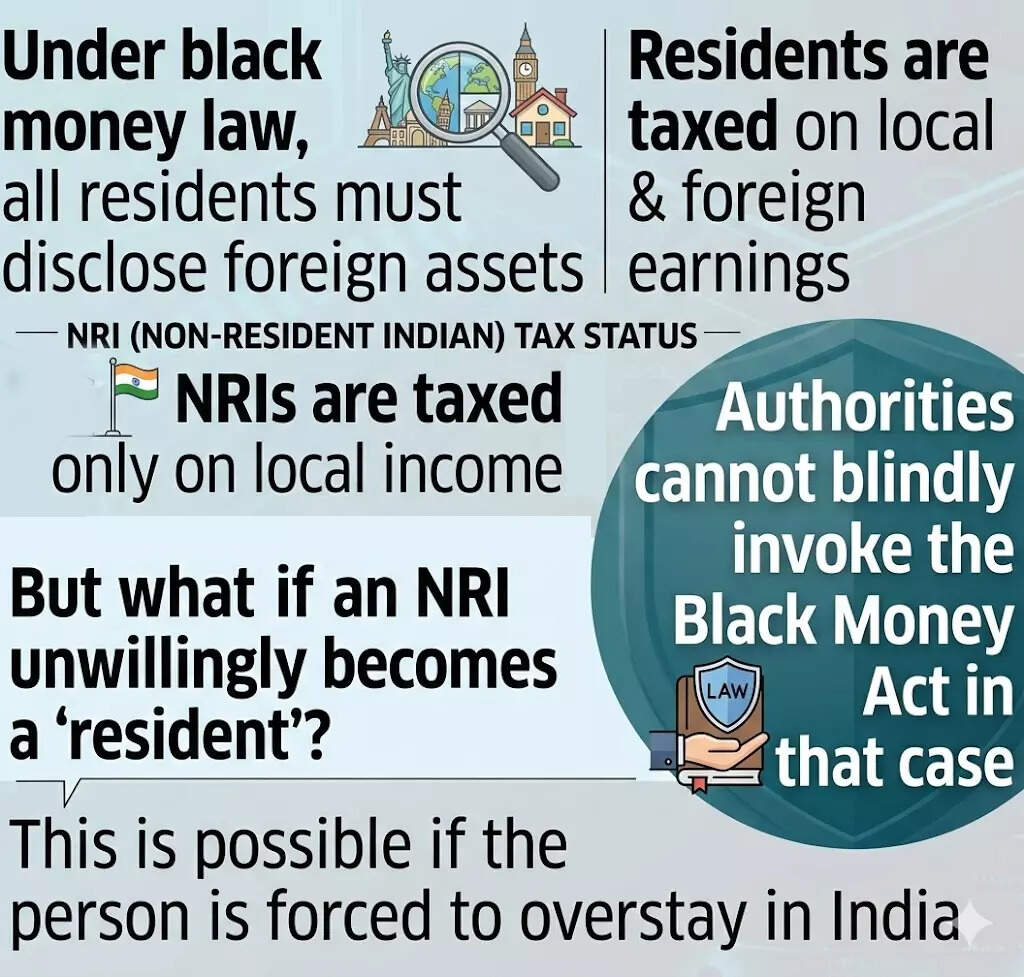
The income tax department had maintained that the Income Tax Act does not differentiate between voluntary and involuntary residence. It argued that since the petitioner had been living in India from January 30, 2019 onward, he should be regarded as a resident and therefore subject to the provisions of the black money law.The court observed that if, during the course of proceedings, the petitioner is found not to qualify as a resident, action under the BMA cannot be pursued.According to the Income Tax Act, residents are liable to pay tax on income earned both in India and abroad, whereas non-resident Indians are not taxed on their foreign earnings. Although the Income Tax Department had sought information on Saxena’s overseas assets by treating him as a resident, it had not issued a formal order in the matter.This raises the issue of whether the BMA can be invoked if the duration of involuntary stay is excluded. In such a situation, the individual would be regarded as a non-resident, and the provisions of the BMA would not apply to non-residents. Introduced by a government that had prioritised the fight against corruption, the BMA was intended to address limitations in the Income Tax Act and enable taxation of undisclosed wealth held abroad, including funds parked in Swiss and offshore bank accounts, assets held through discretionary trusts in tax havens, and stakes in unlisted companies where the real beneficial owners remain concealed.
What legal experts are saying:
“There can be various reasons for involuntary stay, including passport revocation,” said Ashish Karundia, founder of the CA firm Ashish Karundia & Co. “There seems to be no ambiguity in the department’s intent. This was explicitly recognised in circulars no. 11/2020 and 2/2021 issued in not providing blanket exemptions, permitting limited, case-bycase relaxation even during the Covid-19 pandemic, when movements were restricted, and several non-residents were stuck here.”The tax authorities appear to take the view that granting relief beyond truly exceptional circumstances would undermine the legal framework. Such an approach could leave certain individuals without recognised tax residency in any country, effectively making them tax-stateless – an outcome that the Income Tax Act neither envisages nor intends, he said. Because the department followed a case-by-case policy at the time, many NRIs who were unable to travel abroad during the pandemic had to engage with tax authorities on their residential status.Ashish Mehta, partner at the law firm Khaitan & Co told ET that the Black Money Act does not establish a separate process for deciding residential status. Instead, it relies entirely on the classification determined under the Income Tax Act, 1961. Under these provisions, residency is largely decided by the number of days a person is physically present in India. He noted that this classification forms the basic framework for determining tax liability and disclosure requirements relating to foreign income and assets. He also pointed out that shortly before the BMA came into force, the Delhi High Court, in its 2015 judgment in the Suresh Nanda case, ruled that periods of compulsory or involuntary stay in India should be excluded when calculating the duration of presence for determining residential status.
[ad_2]
Source link
Source: Times of India
📝 We use smart aggregation to bring you top news in real-time.