⚡ Auto Brief: This content is part of our real-time syndication stream.
[ad_1]
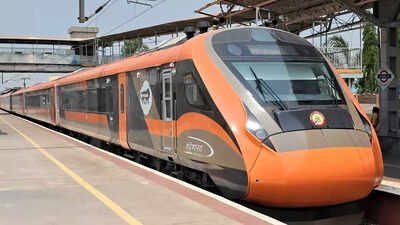
How do the fares of Vande Bharat chair car trains compare to similar trains around the world? According to Railway Minister Ashwini Vaishnaw, the ticket prices for the Vande Bharat chair car are much lower than such trains operating in countries such France, China, and Japan.Vande Bharat chair car is an all air-conditioned service that was first introduced in 2019 and has since then expanded across the Indian Railways network. The self-propelled train set is said to be a world-class offering by the national transporter, allowing for better passenger amenities and faster train travel.
Vande Bharat Chair Car Fares
Recently, Ashwini Vaishnaw informed the Lok Sabha that the fare for the Vande Bharat AC chair car for journeys covering around 300 to 400 kilometres is approximately Rs 2.19 per kilometre. This, he said, is significantly lower than comparable services in countries such as China, Japan and France. “The fare of Vande Bharat AC chair car over a journey between 300 and 400 kilometres is around Rs 2.19 per kilometre, which is much lower than the fares of similar segments of services in countries like China, Japan and France, where it ranges from Rs 7 to Rs 20 per kilometre,” Vaishnaw said.Also Read | How seven new high-speed rail corridors can transform train travel in IndiaIn his written reply, Vaishnaw said the Ministry of Railways determines passenger fares after considering multiple factors, including operational costs, the value and quality of services provided, the nature of facilities offered, affordability for passengers, competition from alternative modes of transport, and broader socio-economic considerations.Vande Bharat train services currently operate across 82 routes, running a total of 164 services. According to the minister, these trains function as a separate category within passenger services, featuring a different fare structure along with amenities such as improved suspension systems, quicker acceleration through semi-high-speed operations, automatic plug doors, ergonomic seating, mini pantry facilities, CCTV surveillance and the KAVACH safety system.Vaishnaw added that passenger affordability has remained a key consideration, and as a result, ticket prices for these trains have been maintained below the actual cost of providing the service.He further said, “The rationalised fare structure has facilitated the wider expansion of these services across the country, reflecting strong passenger demand for these services. Vande Bharat services have high occupancy level on all major routes with occupancy of Vande Bharat near 100 per cent, demonstrating a change in passenger preferences.”Commenting on fares in the ordinary class of other trains, Vaishnaw said these remain among the lowest when compared internationally. Drawing a comparison with neighbouring countries, he noted that the per-kilometre fare in India stands at about 20 paise, while the corresponding fares are 54 paise in Pakistan, 37 paise in Bangladesh and 51 paise in Sri Lanka.Recently a sleeper version of the Vande Bharat Express train has also been launched, and hundreds of such trains are planned for overnight train travel in the coming years.
[ad_2]
Source link
Source: Times of India
📝 We aim to deliver up-to-date headlines with full publisher credit.